It was largely whimsy that drove me here after an internship in Hong Kong. But all roads were leading to Beijing; I'd spent a week here with my dad some weeks before I decided to return, which wasn't merely enough time, I have some great family here (cousins Jonathan and Alexa and their newly 2-year old daughter Ava and uncle-in-law Roger are here) who have been my guiding lights, and friends who've told me to come even as they've issued stern warnings about the place. I was eager to escape Hong Kong, and be part of a city that didn't have the feeling of a modern airport, and I didn't feel like returning to New York.
While in Hong Kong—which is just China's most recent (re)acquisition, but can feel like London or NY—I read of a red dragon that was changing, feeling the pressure that comes with 9 percent year on year economic growth, and the pressure that comes with thousands, millions of people who are losing their homes and farmlands to the factories and dams meant to sustain that growth. I heard and saw a bit of how Beijing, readying for the Olympics, was changing so fast in such (relatively) new ways. Children in backwater Kentucky were studying Mandarin. Either way, I was already over here, and when would I get to come back? I was hungry for more. I asked my cousin for advice and his response was titled "Stay!" Ok, two more months in Asia. I was supposed to return to New York at the end of June. An email in my brain was titled, again, stay.
The hardest part of being here has not been the language or the culture shock, although those have been pretty hard; it's been the environment. I mean the pollution, to which I was quite rudely introduced on my first visit, back in April when the biggest sandstorm of the year struck Beijing, and which has ever since unbalanced my humors. The taste and smell and feel of smog in the air hint at an environmental crisis the government is just beginning to tackle; the ailments that come with all of this could turn anyone into an environmentalist. This week, I happen to be afflicted by a sore throat, runny nose, pounding headaches, upset stomach (the local alcohol will take some of the blame for that), itchy back, and sore feet. The latter is due to the other part of the environment I find less than charming, and it's sort of related to the first part: Beijing's physical environment, its actual spaces. Because of the sheer scale of the city, it's hard to get anywhere except by vehicle; not only are those vehicles great contributors to the city's pollution (the highest sulfur-dioxide levels in the world) but taking a cab or a bus in smoggy Beijing traffic can be an exercise in masochism. The subway is fine, but only fine; not only are its two lines seriously limited in scope and thus its stations few and far between, but in a city of 15 million people, it's always rush hour down there. And with irregular and relatively slow trains and only sparing socialist-style artwork, it's a poor imitation of Moscow's.
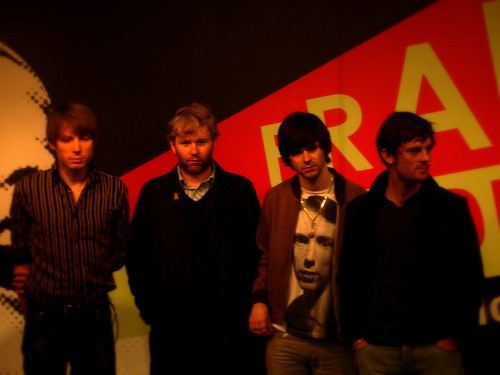
What I'm doing now, besides breathing in excessive amounts of carbon dioxide and all sorts of other junk, writing for magazines here, especially That's Beijing, a fine and substantial English-language monthly which is essentially Beijing's answer to New York magazine (plus light censorship—unlike foreign media, this magazine is overseen in part by the government). It's through that job that I've learned a lot about Beijing and met more than a few characters, like architects, swanky club owners, environmentalists and Dashan, westerner-in-chief (check the photo below--it's not me I promise). The gig was largely thanks to Jonathan (Hollywood Reporter bureau chief) and Alexa (AP reporter), who hooked me into the large journalism scene here. I'm also covering environmental stuff for treehugger.com, which is a nice green living website. I studied Chinese for a month, but after a big spate of writing and a trip to Hangzhou as a roadie for a local punk band that plays Johnny Cash covers (there's a long story there), knocked me off balance. In a good way. Now I'm studying on my own, but I'll need to return to class if I'm going to learn. In the meantime, I've taken to such things as traveling out to the Ming Tombs for a few days to judge an English language competition as a "foreign expert." I know right? I'm also trying to determine next steps. Will China be one of those? Hard to tell. It can be as appealing as it is repelling.
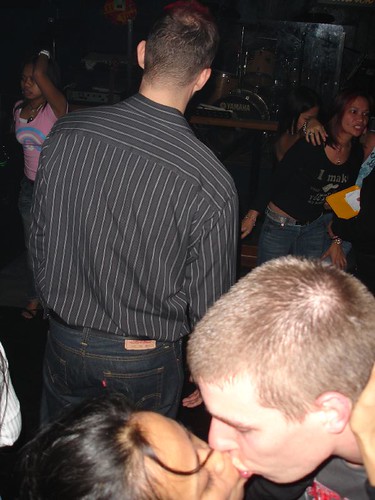
 One wonderful and horrible feature of this country is that you can do whatever you want—as long as it doesn't include voting, protesting, looking at the BBC News website (and sometimes, my god, Google), distributing materials related to the [REDACTED] or writing news articles about natural or environmental disasters without government approval (disasters? No idea what you mean. –Ed.). What do you mean, Alex? For instance, you can get hired as an English teacher, or a "foreign expert" or a consultant or a editor or the president of a company just by showing off your English language skills or diploma from a good American school. Actually, you needn't have gone to the school, but merely mention its brand name—and if you need a diploma from that school, you can always get one printed here. You can walk around, run, or dine with your t-shirt pulled up above your belly without drawing the least bit of attention (except inside banks apparently). You can, if you're a foreigner, receive high praise for your Chinese skills from locals after poorly venturing a phrase or two in Chinese. You can stare at anything or anyone you want, though you must be ready to be stared at as well. You can (and might as well) do a crazy dance whenever you want to (or take all your clothes off onstage, as I saw a friend do recently after his punk show), because you are already always treated like a circus monkey. You can choose to eat a delicious lunch for the price of one American dollar, or you can nosh on an Alaskan black cod with baby bok choy and a cigar for the price of a used Chinese car. If you don't opt for the cod, you can speed your used Chinese car through intersections at high speed paying little heed to pedestrians or bikers, or, assuming you have not already been hit by a car while riding your nifty folding bicycle (I purchased one for half the price you'd pay in the U.S., and it was stolen at double the speed), you can ride your bike anywhere you want without wearing a helmet. If you get hit, you can get high quality care for a pile of money, or, if you're like most people in China, you can lie down on the side of the road for as long as you want, and maybe draw a crowd, while withering away. For a bit more than the price of a car, you can start building your own house (after you have demolished someone else's), or you can spit anywhere you'd like, which you'll have to do if you don't want to taste construction site dust or the Gobi desert all the time. You can buy anything you need at a bargain, and you can sell people items that either don't "work" or aren't "real." You can go around making quotation mark symbols with your hands while speaking without being ridiculed, and you can go for months without knowing the least bit about American pop culture. Or without being in touch with people back home. But mind you: such permissibilities don't necessarily extend across borders. If I've been out of touch it's partly because of distraction. And all of this free-for-all and whirling newness has knocked me off my bearings somewhat.
For instance: my new neighborhood—and my old neighborhood, if you count my first weeks in town when I lived with my cousins. Here we have a convenient portrait of this do-as-you-wish (but, to be fair, not laissez-faire) society. The road is Ya Bao Lu, and if you were to get knocked out somehow (and this is far from improbable on Ya Bao Lu) you might awake to think you've been kidnapped, stuffed into a shipping container and all the dust that involves, and left on some side street on the outskirts of Moscow. The signage contains more Russian than Chinese, and more often than not, the Russian says things like "Cargo," "Shipping," "Train: Peking to Moscow," "Sauna," and so on. This is a land-locked port of sorts, a clearing-house for all things imaginable coming across the continents through central Asia into Beijing and vice versa. It's not completely clear to me why so much stuff is coming through, what that stuff is, and why it's coming through here. But nobody asks questions on Ya Bao Lu, unless the question is "DVD?" or "can I take you somewhere [in my rickshaw]?" or "change rubles?" These questions are asked in Russian by the many Chinese men who congregate on the streets, adding to the surrealism of it all.
 Here are shipping depots that are more than shipping depots, fur coat stores that are more than fur coat stores, night clubs that are more than night clubs, minivans that are more than minivans, banyas that are more than banyas, brothels that are more than brothels, and other more thans that aptly demonstrate the transformative power of capitalism. At night long-legged ladies slip in and out of the clubs and 24-hour shops and cabs, while legions of shirtless Chinese men, a good number from the country's (almost) Islamic western region, Xinjiang, emerge to pack, stuff, tape and load boxes of anonymous goods onto trucks piled dangerously to triple their height and bound for a train, new silk roads, a boat, wherever. By day, the amount of tinted glass on the cars and vans rivals that on the eyes of the many once-athletic, middle-aged Russian men and their gaudily-dressed big bleached-blonde brides, both looking like they've just come from a mafia funeral held at the gym.
The gym is probably not the one at the St. Regis hotel, located not ten minutes away by rickshaw, along with the nicest pool, in a club to which my cousins belong and to which they retire every chance they get. Next to the St. Regis happens to be a range of western-style establishments: a Haagen Daaz café (the fanciest ice cream place I've ever seen), an Americana-laden TGI Fridays, and Pete's Tex-Mex, where satisfactory burritos rule the menu and Willie Nelson rules the stereo, on repeat. The neighborhood has historically been a foreigner-haven, due largely to the fact that you can't spit out the dust in your mouth without hitting an embassy. Not far from me are the embassies of the Democratic People's Republic of Korea, the Democratic People's Republic of the Congo, and other lovely democracies. Actually, Iraq is just across the street from me.
Every night young Iraqi children play football in the alleys and playgrounds within the diplomatic compound in which I live. What is a diplomatic compound and why live in one? I would tell you but then I would have to bore you. To make it short, the place was an offer from Newsweek's bureau chief at a real bargain—1500 yuan down from 6000—but perhaps not when you consider it came unfurnished. However, there is, remarkably, an oven. There is also a real bathtub that says "American Standard" on it in the old cursive writing. Along with the "Norway, Land of the Vikings" mug, this place is pretty foreign—in terms of construction quality (it actually looks quite Soviet, but high Soviet), in terms of population of course, as well as in terms of what I've been used to. I last lived in a modest but still lovely apartment a few subway stops away with a great friend-of-a-friend named Claire, who's been in town off and on since high school. There we shared the traditional curiously-scented bathroom, with showerhead just above the toilet. Adorning the walls were a reprint of a soviet realism painting in which Mao is reposing in a wicker chair in the countryside and a monstrous, unironic and luminsicent photorealistic green and blue painting of a waterfall. A construction site was just across the street from us.
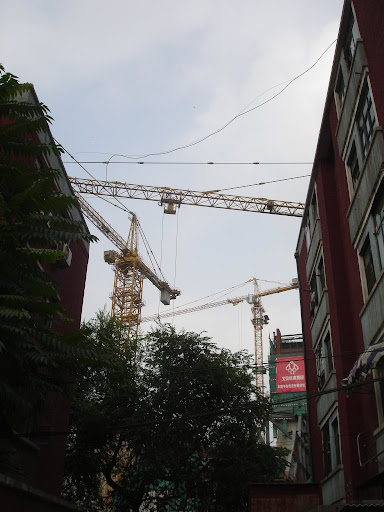 In fact, the whole city is under construction. The weekend I arrived, I accompanied a friend, Elizabeth, who was back in town after a three year stint here, tying up loose ends, to pick up a rug from her old house (it really tied the place together). Her old apartment happened to be inside the hutong, the traditional, low-slung, courtyard housing area that once made up the city as it spread out around the central Forbidden City. The hutong, mostly located within the second-ring road (the road around the Forbidden City being the first), are, like many things here, fast become an endangered species. My very first time here—that is, back in April, when I visited with my dad—I took my first stroll to the south of our hotel, into the neighborhood known as Qianmen. This just so happens to be one of the largest hutong graves in the city, as I soon discovered: dozens of shirtless workmen were lethargically chipping away at the old grey and brown brick and tile with their pickaxes and shovels. Later I watched a group of men yank on a rope, at the other end of which was what remained of a two-story façade.
Elizabeth's old hutong apartment happened to be still intact when we arrived. Actually, it was located in a historic area that had been protected, either before the destructive urge overtook Beijing, or after the fact, possibly with the realization that these hutong houses were a) historic and b) could be used to the cities advantage. While many are being and have been torn up piecemeal to make way for Beijing's future—swathes of shiny malls, office complexes, and apartment buildings named after swanky American neighborhoods, museums, or idyllic gardens—with the added explanation that, with their communal bathrooms and measly plumbing if any, the hutong presented health and safety hazards (not that that concern has ever bothered the government before), some of the hutong will remain. After all, foreigners with very disposable income are arriving in droves, foreigners with a yen to see traditional Chinese ways of life, and a yen, also, to (sort of?) build their own amenity-filled hutong houses and live the life themselves. And there goes the Chinese, out to housing complexes outside of the fifth ring road, and despite everyone's best intentions, there goes the hutong.
China's best intentions now involve building 200 cities of a million-plus people each by 2020, cooling rapid growth of 9 percent a year (but not by too much), and turning Beijing into the international cosmopole it aspires to be by the 2008 summer Olympics. That last word has of course become the mantra of possibility for everyone from officials to school children to construction workers to foreign inhabitants, some of whom, cousins included, also see the Games as a convenient moment to make the crucial "Clash" decision (should I stay or should I go?). Everything feels so provisional, so expectant, but also so uncertain. The word, looming over Beijing with its Olympian connotations, practically has a silent question mark at its end. This is the reason that few of the foreigners I know here feel any pressing need to plan more than a year or so in advance. I was strongly warned that Beijing sucks—I mean, that it sucks you in, the foreigner, with its offers of random opportunity and promises of exciting, ferocious change, to the point where it can be hard to knock the addiction. It's the addiction to danger and absurdity and exuberance and novelty and removal. It's living in a city built on a history unfathomably deep and withering in the face of a future unfathomably unknown, a city now circulating between the unreal drawings of remote architects, the impossible promises of a faceless autocracy, and the environmental dangers of an encroaching desert and encroaching countryside populations. Simultaneously, the verge of utopia and disaster. (Sorry a bit of Chinese exaggeration there!)
 Yeah, it's easy to get lost and disconnect yourself in Beijing. It might be because the world's fastest expanding city—the megapolis, with its five new subway lines this year, and plans for a fifth, sixth, (and seventh? eighth?) ring road—looks like it's lost its memory. Forget nostalgia—with the hutong are also going what remains of the old Beijing. Of course, the Forbidden City and the Summer Palace and the Temple of Heaven and the Yonghegong temple are not going anywhere, and an expansive history is of course the country's biggest point of pride. But as the Olympics calls out to Beijing demanding billions of yuan and an infinity of bamboo scaffolding and steel, no one, no one in command, seems to be looking back. In Berlin, there was kind of a schizophrenic split personality, the corner with preserved war ruins and poor sidewalks and so many memorials to one direction and the futuristic Sony center in the other, bulging and shining. Here the schizophrenia is pointing in only one direction, covering up the dust and the dilapidation and age as quickly as possible. And in a way, who can blame them?
Some historians and urban planners can, especially the foreign ones (the same ones that are moving into the hutong perhaps). But hypocrisies aside (there are many), the urban planners have a good point to make: get rid of the past, but also discard the schizophrenia that might destroy the city. Already enormous in scale and population, already the world's dirtiest traffic jam with 1000 new cars added to its streets daily, Beijing is in desperate need of smart design that it's not getting. Instead of razing the hutong for new foreign complexes or office buildings that are separated from the city and uninviting and deterrent to foot traffic, make things open. Expand roads, make better-designed public transit, add green space. Limit cars. Don't go back to the hutong, but don't forget it either.
The bidding has stopped, the investement is slowing down (if the government can help it). But the building never seems to end. It so happened that the woman now living in Elizabeth's old hutong apartment is an architect—a profession that includes some of the city's biggest foreign celebrities now. Her particular project these days is perhaps Beijing's most ambitious new construction and soon-to-be-icon, the CCTV Tower. The name evokes images of gargantuan, angular and drab Soviet design and great ideological ambitions. The state-owned China Central Television is after all the world's biggest propagandist and maybe the world's biggest television company. The old CCTV tower is already that vision—ugly, boring, triumphal in a broken way, like Berlin's tragic TV tower.

The CCTV Tower she is working on is nothing like the old one, or like anything else. CCTV wanted a skyscraper to house all 10,000 of its employees. Architect Rem Koolhaas, brutal, insane Dutch visionary, and his Office of Metropolitan Architecture, twisted that skyscraper into an impossibly folded, leaning loop of a building that Borges might have described somewhere. It's crazy-looking, frustrating and awe-inspiring, and, from what I've learned (at length—I had the chance to interview the architect, not Koolhaas but his protégé, Scheeren, who's managing the project here) it's kind of a logo for the city's more forward-thinking ambitions (public access, public space) I think, and for what's so thrilling about being here now. (Also see the new "bird's nest" stadium, below).

Sometimes it's exciting in a not so fun way. For instance: visa renewal. Not wanting to deal with that hassle not long ago, I planned a quick escape to
Mongolia. From there I could reenter with a new visa, and see some of Genghis Khan's old dunes and steppes. The other ways of renewing your visa, as far as I know, are good illustrations for the ways one does anything in
China. The first way is to go to the Public Security Bureau and stand on one line for ten minutes before realizing that you must first fill out a form which happens to be hidden on a desk in a corner of the room and which requires a photograph that can be made after you stand on another line, after which you wait on yet another line to deliver the form to a immigration official but not before you've gone back downstairs to photocopy your residence permit (getting which is another adventure). When that's all done, they ask you to come back in a week, and wait on two more lines (one to pay for the thing the other to actually get it). The other option is to search the back of one of the expat magazines for a phone number, the voice on the other end of which promising to get you any sort of visa you want for a price.
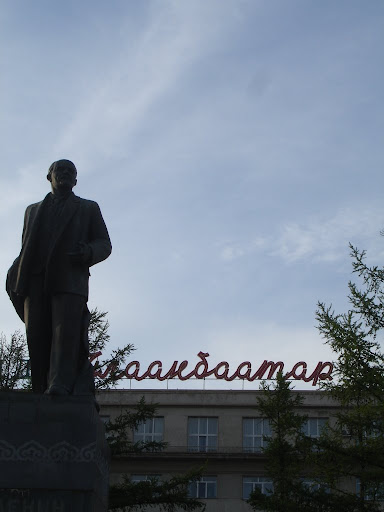 So not wanting to pay the price, and eager for the adventure, I got on a train in Genghis Khan's one-time capital and headed for the capital of his own country. It was after all the 600th anniversary of his empire, and it was a happy coincidence that three friends (Sarah, Abigail, and David, whose nom de voyage was s.a.d.) would be coming to Mongolia via trans-Siberian train shortly. I rushed to the station (well not quite, there's another long story of lines and such here) and purchased a ticket for Ulan-Bator. Strange and decaying, and only recently entering what might be called the developed world, the city was awash in Soviet concrete and newer cheap construction of the colored-glass-and-tile sort—the dusty question mark at the end of what was the world's most influential empire.
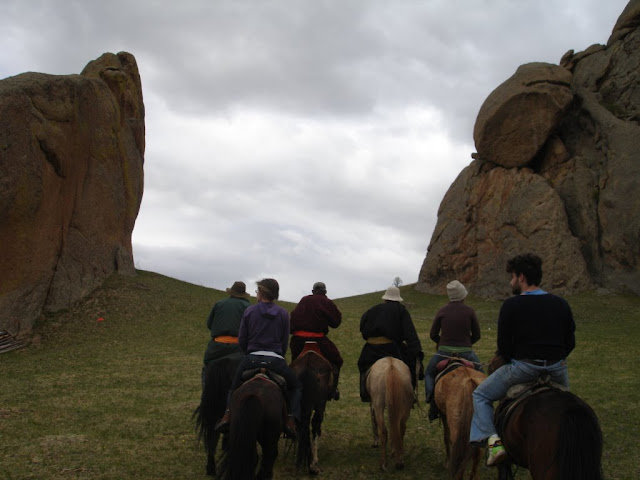
On the surface however, it is mostly a living relic not of the Mongols influence but the Russians. The most memorable building today is the gargantuan cultural center, located near the central Sukbahtor Square; more than anything, it resembles a Stalinist cruise ship, with a fake golden trim at its towering deck, and barren columns running along the bow. What windows there were were either barred or dark yellow with dust. It would have seemed empty if not for the modern art museum I discovered in one of its atria, and the musical performance that was taking place the first day I visited, complete with women in feathers and men in Mohawks and leather. Some young fashionable men stopped me as I wandered through an alleyway nearby; they turned out to be local hipsters, and one of them, a DJ at the local rock radio station, which was also housed in the building, proudly gave me a brief tour by map of the city. Yurts dotted the edges of town and the edges were not far from the center; unlike china, expansion was not in the cards, not now. The folk cultures and its trappings—wrestling, herding, riding—were alive and well inside the city, where preparations were ongoing for the annual Nadaam festival, a cultural extravaganza held every July. Because of the anniversary, this one would be especially important. We escaped quickly to the countryside to ride horses, live in a yurt, drink salty Mongolian tea, and confound ourselves by standing on hilltops staring at deeply-colored green landscapes under blue and pink and red skies all on a scale I've never seen. Overtaking one green hill or seductive sand dune only to encounter another on the opposite side, one can imagine—again paraphrasing Becker—the temptation to own the world that must have overcome Chingis Khan.
Of course, the Tatars and the Russians sought to undo not only that temptation but the very legacy of Khan with their own conquering in the past two centuries—the most bloody landmarks of which involved a rogue and insane Siberian baron and a deputy of Stalin who carried out an order no other Russian emissary could: to execute thousands of monks, along with their monasteries. The least populated country in the world got no help from its other neighbor, the most populous country in the world, which has been no less fierce, but perhaps more clever, with its own imperialism. The train to Tibet just opened—cousin alexa went on the first voyage as the AP's correspondent—a symbolic and literal assertion of China's control over that region. The more nationalist of the Uighurs over in Xinjiang—China's northwest and largest territory—from which the people who hang at the Muslim dives on my street come—have lately been rebranded as Muslim terrorists. (A few were actually captured in Afghanistan and sent to Guantanamo for a few years before the US realized they were harmless; instead of returning them to China, where they would face certain death, the US repatriated them to Slovenia or something.) The Xinjiang region is a lovely mix of nationalities and ethnicities and foods and un-Chinese languages. But China has banned the teaching of Uighur, and is fast flooding the place with Han settlers. I'm planning on getting out there soon myself.
 Ok enough of this long march; let's have a nice long August. Please let me know where and what and when you are.
 One wonderful and horrible feature of this country is that you can do whatever you want—as long as it doesn't include voting, protesting, looking at the BBC News website (and sometimes, my god, Google), distributing materials related to the [REDACTED] or writing news articles about natural or environmental disasters without government approval (disasters? No idea what you mean. –Ed.). What do you mean, Alex? For instance, you can get hired as an English teacher, or a "foreign expert" or a consultant or a editor or the president of a company just by showing off your English language skills or diploma from a good American school. Actually, you needn't have gone to the school, but merely mention its brand name—and if you need a diploma from that school, you can always get one printed here. You can walk around, run, or dine with your t-shirt pulled up above your belly without drawing the least bit of attention (except inside banks apparently). You can, if you're a foreigner, receive high praise for your Chinese skills from locals after poorly venturing a phrase or two in Chinese. You can stare at anything or anyone you want, though you must be ready to be stared at as well. You can (and might as well) do a crazy dance whenever you want to (or take all your clothes off onstage, as I saw a friend do recently after his punk show), because you are already always treated like a circus monkey. You can choose to eat a delicious lunch for the price of one American dollar, or you can nosh on an Alaskan black cod with baby bok choy and a cigar for the price of a used Chinese car. If you don't opt for the cod, you can speed your used Chinese car through intersections at high speed paying little heed to pedestrians or bikers, or, assuming you have not already been hit by a car while riding your nifty folding bicycle (I purchased one for half the price you'd pay in the U.S., and it was stolen at double the speed), you can ride your bike anywhere you want without wearing a helmet. If you get hit, you can get high quality care for a pile of money, or, if you're like most people in
  Here are shipping depots that are more than shipping depots, fur coat stores that are more than fur coat stores, night clubs that are more than night clubs, minivans that are more than minivans, banyas that are more than banyas, brothels that are more than brothels, and other more thans that aptly demonstrate the transformative power of capitalism. At night long-legged ladies slip in and out of the clubs and 24-hour shops and cabs, while legions of shirtless Chinese men, a good number from the country's (almost) Islamic western region, Xinjiang, emerge to pack, stuff, tape and load boxes of anonymous goods onto trucks piled dangerously to triple their height and bound for a train, new silk roads, a boat, wherever. By day, the amount of tinted glass on the cars and vans rivals that on the eyes of the many once-athletic, middle-aged Russian men and their gaudily-dressed big bleached-blonde brides, both looking like they've just come from a mafia funeral held at the gym.
 In fact, the whole city is under construction. The weekend I arrived, I accompanied a friend, Elizabeth, who was back in town after a three year stint here, tying up loose ends, to pick up a rug from her old house (it really tied the place together). Her old apartment happened to be inside the hutong, the traditional, low-slung, courtyard housing area that once made up the city as it spread out around the central
  Yeah, it's easy to get lost and disconnect yourself in
  The CCTV Tower she is working on is nothing like the old one, or like anything else. CCTV wanted a skyscraper to house all 10,000 of its employees. Architect Rem Koolhaas, brutal, insane Dutch visionary, and his Office of Metropolitan Architecture, twisted that skyscraper into an impossibly folded, leaning loop of a building that Borges might have described somewhere. It's crazy-looking, frustrating and awe-inspiring, and, from what I've learned (at length—I had the chance to interview the architect, not Koolhaas but his protégé, Scheeren, who's managing the project here) it's kind of a logo for the city's more forward-thinking ambitions (public access, public space) I think, and for what's so thrilling about being here now. (Also see the new "bird's nest" stadium, below).
 Sometimes it's exciting in a not so fun way. For instance: visa renewal. Not wanting to deal with that hassle not long ago, I planned a quick escape to
  So not wanting to pay the price, and eager for the adventure, I got on a train in Genghis Khan's one-time capital and headed for the capital of his own country. It was after all the 600th anniversary of his empire, and it was a happy coincidence that three friends (Sarah, Abigail, and David, whose nom de voyage was s.a.d.) would be coming to
  Ok enough of this long march; let's have a nice long August. Please let me know where and what and when you are.